
Editor’s Note — Updated September 2026: This article was adapted from a 2013 European Geosciences Union GeoLog post about hydrogen bonding and water’s unusual physical properties. We have corrected a reversal of the partial electrical charges in the original text and added updated context about molecular-hydrogen research.
Water is a polar molecule. Because oxygen attracts the shared electrons in each oxygen–hydrogen bond more strongly, the oxygen atom carries a partial negative charge (δ−), while the two hydrogen atoms carry partial positive charges (δ+). This uneven distribution of charge enables hydrogen bonding—the attraction between the partially positive hydrogen of one water molecule and the partially negative oxygen of another. Hydrogen bonding helps explain water’s cohesion, adhesion, surface tension and many of the properties that make water essential to biological systems.
Molecular hydrogen (H₂) dissolved in water is different from the hydrogen atoms chemically bound within water molecules (H₂O). Researchers are investigating whether dissolved H₂ may influence oxidative-stress and inflammatory-signaling pathways. An early laboratory and animal study reported that H₂ selectively reduced hydroxyl radicals, but current human evidence remains preliminary. A 2024 systematic review found encouraging results across several areas while concluding that larger, more rigorous clinical trials are still needed. Molecular hydrogen should therefore be presented as an emerging field of research—not as a proven treatment or as something established to eliminate harmful free radicals throughout the body.
This article sheds light on the activity of hydrogen when introduced into the body through supplementation. Hydrogen may scavenge dangerous free radicals of oxygen and turn them into more water for the body, a very good thing. This is why we love hydrogen boosting products for better health, like MegaHydrate and the HydroGO+.Imaggeo on Mondays: The name’s Bond. Hydrogen bond.
The oxygen atom in H₂O attracts shared electrons toward itself because oxygen is more electronegative than hydrogen. This gives the oxygen end of the molecule a partial negative charge and the hydrogen atoms partial positive charges. The attraction between the partially positive hydrogen of one molecule and the partially negative oxygen of another creates a hydrogen bond.

Water molecules are drawn together by hydrogen bonding – attraction between negative hydrogen atoms and positive oxygen atoms. (Credit: Wikimedia Commons user Qwerter)
Hydrogen bonding is what gives water its adhesive and cohesive properties, allowing water to form thin films as it spreads of smooth surfaces (adhesion), and stick together (cohesion) as droplets, that can fall as rain, collect on the surface of a leaf, or obscure your hand lens as you try your best to do fieldwork in bad weather.
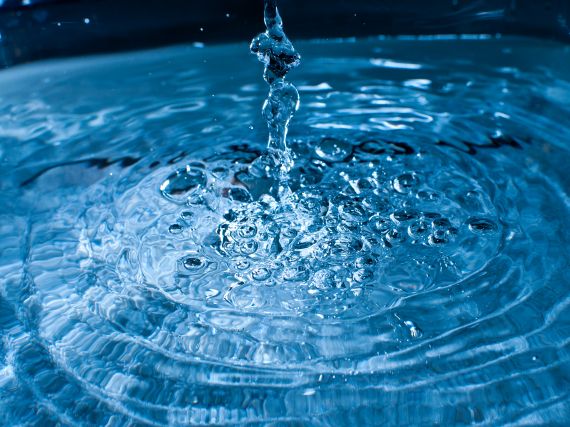
“Water drops” by Jacqueline Isabella Gisen, distributed by the EGU under a Creative Commons licence.
This photo by Jacqueline Gisen captures the cohesive nature of water. She explains that “cohesive forces make water molecules to attracted to each other from every direction,” but because the water’s surface is exposed to the atmosphere (where there is relatively few water molecules) it can only be pulled down towards the rest of the fluid. This creates surface tension, responsible for the bouncing droplets you see when one source of water pours into another.
Imaggeo is the EGU’s open access geosciences image repository. A new and improved Imaggeo site will be launching soon, so you will be able to peruse an even better database of visually stunning geoscience images. Photos uploaded to Imaggeo can be used by scientists, the press and the public provided the original author is credited. Photographers also retain full rights of use, as Imaggeo images are licensed and distributed by the EGU under a Creative Commons licence. You can submit your photos here.