
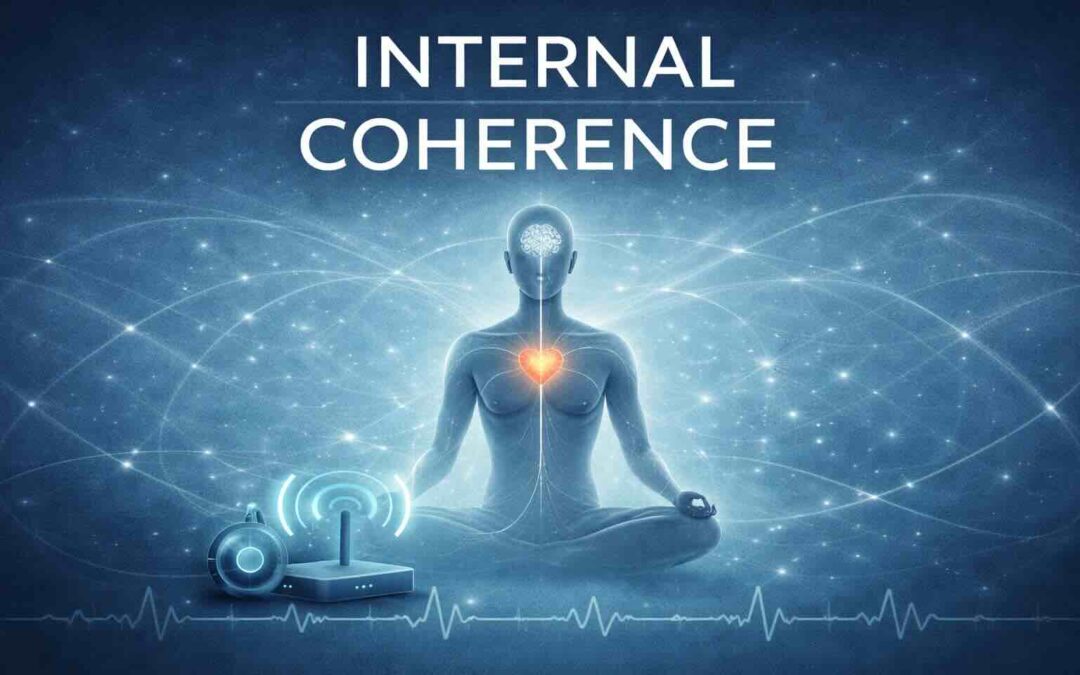
Heart–brain coherence refers to a measurable physiological state in which heart rhythms, neural signaling, and emotional regulation operate in synchronized patterns. This coordinated activity is primarily mediated through the autonomic nervous system and the vagus nerve, which continuously relay signals between the heart and brain.
When heart rhythms become ordered and rhythmic, the brain receives clearer biological signals that support cognitive clarity, emotional stability, and adaptive stress responses. Researchers often evaluate this interaction using heart rate variability (HRV), a biomarker that measures the subtle timing differences between heartbeats.
This article is part of the Coolest Tech Ever research library, which explores the physiology of stress regulation, hydration science, environmental stress, and emerging technologies that support whole-body resilience.
Key Insight: Heart–brain coherence reflects a nervous system that can adapt fluidly to challenge. When heart rhythms become organized, the brain processes information more efficiently and recovery from stress improves.
Quick Summary
- Heart–brain coherence describes synchronized communication between heart rhythms and brain activity.
- The interaction is measured through heart rate variability (HRV).
- Higher HRV generally reflects stronger nervous-system adaptability.
- Coherence supports cognitive clarity, emotional stability, and resilience to stress.
- Practices such as breathing exercises, meditation, hydration, and HRV biofeedback may support coherent physiological patterns.
Explore the Science of Coherence
Heart–brain coherence sits at the intersection of neuroscience, physiology, and emotional regulation. Our research hub examines how hydration, environmental stress reduction, and HRV-based biofeedback tools may influence nervous-system stability.
Explore Heart–Brain Coherence Tools →
The Conversation Between Your Heart and Brain
For many years, discussions about heart health focused primarily on blood pressure, cholesterol levels, and cardiovascular fitness. While these metrics remain important, modern neurocardiology research shows that the heart also plays a critical role in emotional processing and cognitive function.
The heart generates the largest measurable electromagnetic field in the human body. This signal interacts with the brain through neural pathways, hormonal signaling, and the vagus nerve — a major component of the parasympathetic nervous system.
When heart rhythms become smooth and rhythmic, communication between the heart and brain becomes more stable. This coordinated signaling produces what researchers call physiological coherence.
In coherent states, individuals often report clearer thinking, improved emotional balance, and faster recovery from stress.
What Is Heart Rate Variability?
Heart rate variability (HRV) measures the variation in time between consecutive heartbeats. Contrary to what many assume, a healthy heart does not beat with mechanical precision.
Instead, a resilient nervous system constantly adjusts heart rhythm in response to breathing patterns, emotional states, and environmental demands.
Research from the National Center for Biotechnology Information shows that HRV is closely associated with autonomic nervous-system balance and emotional regulation.
Higher HRV generally reflects greater adaptability, while chronically low HRV may correlate with prolonged stress exposure.
Why Regulation Matters in the Modern Environment
Modern environments rarely threaten survival directly, yet they continually stimulate the stress response. Digital notifications, irregular sleep patterns, environmental exposures, and constant cognitive load keep the nervous system subtly activated.
This persistent activation can narrow emotional flexibility and reduce recovery capacity.
According to the National Heart, Lung, and Blood Institute, chronic stress influences cardiovascular regulation, immune function, and metabolic stability.
Coherence helps counterbalance this background activation by restoring rhythmic signaling between the heart and brain.
Evidence Overview: HRV and Physiological Regulation
| Research Area | Key Findings | Evidence Source |
|---|---|---|
| Autonomic nervous system regulation | HRV reflects balance between sympathetic and parasympathetic activity | NIH / NCBI research |
| Stress resilience | Higher HRV associated with improved emotional regulation | Psychophysiology studies |
| Cognitive performance | Coherent heart rhythms linked to improved focus and decision-making | Neuroscience research |
| Inflammation modulation | Autonomic balance may influence inflammatory signaling pathways | PubMed research |
Explore the CoolestTechEver Research Hub
The CoolestTechEver research hub explores the science of environmental stress, hydration, nervous system regulation, and emerging wellness technologies that support resilience and an anti-inflammatory lifestyle.
- Hydration and Cellular Health
- Environmental Stress and Nervous System Regulation
- What ia Heart–Brain Coherence?
- EMF and Sleep Science
- Hydrogen and Redox Biology
- Scientific Research Library
These guides connect peer-reviewed research, environmental health science, and emerging technologies designed to support physiological stability and recovery in modern environments.
Visual Framework: The Coherence Ladder
Foundation
Adequate hydration, sleep stability, and balanced breathing patterns
Nervous System Regulation
Autonomic balance supported through rhythmic breathing and relaxation practices
Biofeedback Awareness
HRV monitoring and physiological awareness tools
Coherent Performance
Cognitive clarity, emotional balance, and resilience under pressure
The Coherence Stack: Whole-Body Stability
FOUNDATION
Hydration, nutrition, and metabolic balance
ENVIRONMENT
Reduced environmental stressors including sleep disruption and electromagnetic exposure
REGULATION
Breathing practices, meditation, and emotional awareness
TECHNOLOGY
HRV biofeedback tools and coherence training devices
How Heart–Brain Coherence Improves
The encouraging news is that coherence is trainable. It is not limited to athletes or meditation experts. The nervous system adapts to rhythmic signals through repetition.
Slow breathing patterns are one of the most effective entry points. Breathing at approximately five to six breaths per minute can stimulate vagal tone and encourage coherent heart rhythms.
Research summarized by the PubMed demonstrates that emotional states such as appreciation, compassion, and gratitude are associated with coherent HRV patterns.
These emotional states function as biological signals that stabilize the nervous system.
A Gentle Starting Practice
If you’d like to explore a simple entry point into heart-centered awareness, this guided meditation offers a supportive introduction.
Guided practice: Heart-Centered Meditation Practice
The exercise encourages awareness of breath and attention toward the chest — two anchors that help regulate heart rhythms.
Coherence builds gradually through daily repetition rather than intensity.
Practical Strategies for Supporting Coherence
- Practice slow rhythmic breathing for several minutes daily
- Develop awareness of emotional states that stabilize the nervous system
- Support hydration and metabolic stability
- Reduce environmental stressors that disrupt sleep and nervous-system balance
- Use HRV biofeedback tools for real-time awareness
Foundational lifestyle inputs such as hydration, sleep quality, and environmental stress reduction also influence nervous system stability. For a deeper look at hydration’s role in physiological regulation, see our Hydration and Cellular Health pillar guide.
Research Snapshot
Scientific investigations from organizations including the National Institutes of Health, the National Heart, Lung, and Blood Institute, and peer-reviewed neuroscience journals have explored the role of heart rate variability in emotional regulation, cardiovascular health, and stress resilience.
These studies indicate that coherent heart rhythms may influence autonomic nervous system balance, inflammatory signaling pathways, and cognitive performance.
Research and References
- NCBI — Heart Rate Variability and Autonomic Nervous System Regulation
- National Heart, Lung, and Blood Institute — Stress and Cardiovascular Health
- PubMed — HRV as a Biomarker of Stress and Emotional Regulation
- World Health Organization — Stress and Health
- PubMed — Heart Rate Variability as a Biomarker of Stress and Emotional Regulation
- Environmental Health Trust — Scientific Research on Environmental Exposures
- Institute of Noetic Sciences — Research on Consciousness and Human Potential
Frequently Asked Questions
What is heart–brain coherence?
A physiological state where heart rhythms and brain activity operate in synchronized patterns, supporting emotional and cognitive regulation.
What does HRV measure?
Heart rate variability measures the timing differences between heartbeats, providing insight into nervous-system adaptability.
Can HRV be improved?
Practices such as breathing exercises, meditation, adequate sleep, and hydration may support HRV and nervous-system balance.
Is coherence the same as relaxation?
No. Coherence reflects organized physiological rhythms that allow individuals to remain stable even during challenge.
Do HRV devices help?
Biofeedback devices can provide real-time insight into nervous-system patterns, helping individuals train toward greater coherence.
Explore the Full Research Library
Discover additional research on hydration, environmental stress, nervous-system regulation, electromagnetic environments, and emerging wellness technologies.
Visit the CoolestTechEver Research Library
For years, conversations about heart health have focused almost exclusively on heart rate, cholesterol, and blood pressure. Those metrics matter, of course. But they don’t tell the whole story.
There is another dimension of heart health — one that directly affects how clearly you think, how resilient you feel, and how well you handle pressure. It’s called heart–brain coherence, and it may be one of the most important physiological skills we can cultivate in a fast, overstimulated world.
This isn’t poetic language. It’s measurable biology.
The Conversation Between Your Heart and Brain
Your heart is far more than a mechanical pump. It generates the largest measurable electromagnetic field in the body, and it is in constant communication with the brain through the vagus nerve and the autonomic nervous system.
When this communication is smooth and rhythmic, the body enters a state known as coherence. In this state, heart rhythms become ordered and harmonious, and the brain responds accordingly. Thinking becomes clearer. Emotional responses soften. Recovery speeds up.
Scientists measure this interaction through Heart Rate Variability (HRV) — not the speed of your heartbeat, but the variation in time between beats. A healthy nervous system does not beat like a metronome. It adapts. It flexes. It responds.
Higher, balanced HRV generally reflects greater adaptability. Lower HRV often correlates with chronic stress and reduced resilience. Coherence represents a pattern of variability that is organized and efficient — a nervous system that can meet life without fragmenting.
Why This Matters Now
Modern life rarely threatens us physically, yet it continuously activates our stress response. Notifications, deadlines, digital stimulation, disrupted sleep, environmental load — all of it keeps the nervous system subtly braced.
Over time, this low-grade activation narrows emotional bandwidth. It becomes harder to recover. Harder to focus. Harder to regulate reactions.
Many people attempt to solve this cognitively — through productivity systems or mindset shifts. But the nervous system does not respond to arguments. It responds to rhythm.
Coherence restores flexibility. And flexibility is not weakness — it is strength. It is the ability to remain steady in motion.
Coherence Is Not Bliss. It Is Stability.
There is a misconception that nervous system regulation means becoming soft, passive, or perpetually calm. In reality, coherence is not about eliminating intensity. It is about remaining organized during intensity.
When the heart and brain are in sync, you can handle challenge without tipping into overwhelm. You can make decisions without emotional static. You can engage fully and then recover cleanly.
This is why HRV has become a respected biomarker among elite performers, clinicians, and resilience researchers. Not because it promises serenity, but because it reflects adaptability.
You cannot sustainably outperform your nervous system’s stability.
How Heart–Brain Coherence Improves
The encouraging news is that coherence is trainable. It is not reserved for monks or athletes. It is a physiological skill that responds to practice.
Breathing patterns are one of the most accessible entry points. Slow, rhythmic breathing — especially with slightly longer exhales — stimulates the parasympathetic nervous system and encourages coherent heart rhythms.
Emotional states also matter. Research shows that feelings such as appreciation, compassion, and genuine gratitude produce measurable coherence patterns. These states are not forced positivity; they are stabilizing signals.
Technology can help as well. Biofeedback tools that measure HRV in real time allow you to see whether you are regulated or reactive. This feedback is not about judgment. It’s about awareness. When the body can see itself, it adjusts more efficiently.
A Gentle Starting Point
If you’d like a simple and supportive place to begin, this heart-centered meditation from Yoga with Adriene offers a beautiful introduction:
👉 https://youtu.be/fNLPZnUE1rg
The practice guides attention toward the chest and breath — two powerful anchors for coherence. No equipment is required. Just your breath and a few minutes of presence.
Small daily practices accumulate. The nervous system learns through repetition, not intensity.
Technology as Support, Not Replacement
At Coolest Tech Ever, we explore tools that support biological intelligence — hydration, EMF awareness, vibrational integrity, and increasingly, nervous system literacy.
HRV devices are not simply fitness trackers. They function as mirrors. They reveal patterns that are otherwise invisible. And once you can see those patterns, you can train toward stability.
Technology works best when it supports self-awareness, not replaces it.
The Bigger Picture
Heart–brain coherence influences far more than mood. It affects cognitive clarity, immune response, social connection, creative flow, and recovery capacity. When the heart’s signal becomes organized, the brain operates differently.
In a world that constantly asks for output, coherence invites sustainability. It reminds us that the foundation of performance is not urgency — it is regulation.
The future of health may not be about pushing harder. It may be about reducing internal interference so the body’s natural intelligence can function optimally.
And that begins with rhythm.